Friday, January 4, 2013

Fix It or End It: The Only Two Options for Bad Relationships

In my last post, I discussed some characteristics of healthy and unhealthy relationships. I'm always a little surprised at the sheer number of people I encounter that indicate their relationship has major problems. Many times it's manifested as "My spouse has a serious problem with me running barefoot." When I dig a little deeper, that seemingly minor issue is a symptom for far deeper issues.

I shouldn't be surprised, though. I've been in bad relationships. I was married previously. My current relationship with Shelly hasn't always been muffins wrapped in rainbows. In both situations, I knew I was in a bad relationship for a long time before deciding to take action. The gist of this post is just that- a guide on how to take action.

Once you acknowledge you're in a bad relationship, a decision must be made:

Fix it or end it.

Simply continuing is not fair to you or your partner. Life is far too short to spend in a shitty relationship. If your partner keeps you from being the best you can possibly be (or vice versa), you're wasting the precious little time you have.

Excuses


Most people that stay in bad relationships use a litany of excuses to justify and rationalize inaction. Some of the most common:
  • We have kids together. What's worse- having two happy parents that aren't in a relationship together or two bitter, angry parents modeling a loveless marriage? If you think the latter is better for your kids' well-being, please stop reading my blog.
  • We've been together for a long time. This is the anthem of the unhappy. No matter how much time and effort you've spent on anything, be it a relationship, career, or jig saw puzzle, we have to look at the effect it has on us right now. Imprisoning yourself in a world of misery for the future based on past happiness is flat-out stupid. Learn to rejoice the past, cut your losses, and create a better future.
  • "Everyone has problems. There are ups and downs in all relationships. Relationships are hard." WRONG. If a relationship is hard, you're doing it wrong. The hard part of relationships is recognizing and admitting our own faults, then fixing them so they don't pollute our relationship. There are lots of people in great relationships, and they do it with ease. Why? They're secure, healthy individuals.
  • The entire relationship isn't bad. Most relationships have some good elements. There are a few good times mixed in with the bad, and those few good times can be enough to motivate inaction.
  • We're working on it, but not really working on it. This may be the most insidious excuse of them all because it gives the illusion of improvement. In many relationships, this involves a series of behaviors where the relationship sours, both people change their behavior pattern for a period of time and the relationship temporarily improves, then both slip back into the same old destructive behaviors.
None of these reasons are valid excuses to maintain a shitty relationship, which leads back to the two possible options- really fix it or end it.

In my own relationships, I had to make that decision. I ended one, decided to really fix the other. Both situations ended up working out for the better for all parties involved.

Before we get to the point where we try to fix a relationship, we should probably assess if the relationship is worth saving. Here are few pretty easy cases:
  • If one or both partners are physically or emotionally abusive, the relationship probably needs to end, especially if there's children involved. 
  • If both people just aren't into each other anymore, the relationship should end. This is actually the best-case "breakup" scenario.
  • If one partner has no interest in continuing as a couple, it should probably end. You can't force someone to love another.
  • If the people are fundamentally incompatible (vague description, I know), it should probably end.
Here's a quick and dirty test. Ask yourself how you would feel if you never saw your significant other again. If your honest gut response is "relieved", it's time to end it.

Yes, it's hard to end a relationship. There are a lot of costs associated with the decision. There may be kids involved. There's shared property. Family. Common friends. Pets. However, deciding to leave a bad relationship may be the best thing for you personally. If you're not growing as a person, you're not living up to your fullest potential. If that's not motivating, your partner is suffering the same fate. You're keeping them from being the best possible person they can be. If you have kids, you'll spend their childhood modeling bad relationship habits. Where do you think your bad relationship habits came from? Are you comfortable knowing you're setting them up for the same strife you're experiencing right now? If the relationship needs to end, end it.

There's more gray area if both people really want the relationship to continue, but have significant issues that cannot be overcome. This is where we REALLY fix the relationship. I would strongly suggest giving it one last shot with the understanding that using the same methods that failed to resolve issues in the past will not fix current problems. Most relationship problems stem from the bad relationship patterns we learned earlier in life. We simply don't have the tools to fix our own problems, let alone relationship problems.

In that case, I would highly recommend seeking individual professional help. A good therapist can help us work through our own issues so we can be part of a healthy relationship. IT'S IMPORTANT FOR BOTH PEOPLE TO DO THIS! Once each person has worked through their issues, then we can seek the help of a good couple's therapist to teach us the relationship skills to make a great relationship.

If only one member of the couple seeks help, the relationship will fail. This is common when one person is blamed for the problems in the relationship, which is never the case. BOTH people need to solve their issues or the relationship will continue to suck.

If you're in a bad relationship, I challenge you to take action today. Really fix it or end it. Life's too short to take any other path.

The next post in the series will discuss how we end relationships.

###

\

Thursday, January 3, 2013

Am I In a Bad Relationship?

This is the first in a multi-part series about healthy relationships. I'll be discussing what constitutes a healthy relationship,what patterns of behavior define an unhealthy relationship, and what to do if you're in a bad relationship. 

First, what does a healthy relationship look like? Most healthy relationships heavily feature these qualities:
  • Respecting each other as individuals, which includes accepting their thoughts, opinions, decisions, activities, and social network. If they want to be a professional dominatrix, we help them shop for whips.
  • Excellent communication, including nonjudgmental active listening, willingness to compromise, and seeking mutually-beneficial solutions to problems. If they hate the way we put the toilet paper on the roll, we acknowledge how they feel and work out a solution that makes everyone happy.
  • Fairness in financial arrangements, household and parental duties, and time allowed to devote toward individual pursuits. I'll change all the poopie diapers if you give me the time to go for a long run on the weekend.
  • Honesty and accountability in all aspects of the relationship, which includes mutual trust and the ability to accept personal responsibility. If your emotional baggage is dragging the relationship down, admit it and fix the problem.
  • Maintain an atmosphere of safety where each partner is free to express themselves in thoughts and actions. Each person should feel the freedom to say or do what they want, which could feasibly include ending the relationship.
A shortened version- each partner helps the other grow as a person.

So what about bad relationships? 

There are a million possible negative behavior patterns found in relationships... here are a few:
  • We try to change our partner. We spend a significant amount of time and effort trying to change others, which is always futile. The only people we can change are ourselves. If your partner doesn't want kids, trying to convince them otherwise simply will not end well.
  • We expect perfection. We have a relationship ideal (think fairy tales) and hold our partner to that standard. If your relationship ideal comes from Disney movies, you're not going to be very successful in the love game.
  • We expect early or better days of the relationship to last forever. Almost all relationships start off great because both partners are deluded by brain chemistry, which causes us to ignore faults. When that passes, we hold our partner to that same early standard. He's not going to give you flowers and poetry every day anymore. She's not going to give you enthusiastic blowjobs after a night out at the bar anymore. We're not in a relationship with the person that was wooing us; we're in a relationship with the person they really are.
  • We expect our partner to meet the needs we should be meeting ourselves. We rely on our partner to give us affirmations to fuel our self-esteem, which eventually turns the relationship into a job for them. Need them to compliment your new dress to feel good? That's a problem.
  • We try to force them to love us. We believe if we love them enough, all the relationship or individual problems will disappear. Contrary to popular belief, love doesn't conquer all.
  • We ignore reality and fail to fix the significant problems. The relationship may be crumbling but we delude ourselves into thinking everything is okay (or it's just a rough patch.)This is the classic "They [insert relationship-ending behavior] with no warning at all! I thought everything was great!" situation. Everything wasn't great. You just deluded yourself into ignoring how shitty the relationship became.
  • One or both partners have no ability to empathize. Successful relationships require partners to see things from the others' perspective, which makes it impossible to really love and trust each other.
  • We expect our partner to know what we want and need. None of us are mind-readers (though it's not a hard skill to fake.) If we don't have excellent communication to express our needs, anger and resentment develop.
  • We lack real intimacy. Intimacy is developed via open, honest reciprocal self-disclosure. We essentially make ourselves vulnerable to each other.
  • We don't understand how trust works. There's a tendency to go to extremes of either blindly trusting a partner or having no trust in them at all. In healthy relationships, trust is adjusted based on relationship dynamics and situations. If you're blindsided by your partner's behaviors, see the comment above about ignoring significant problems.
  • We have too much emotional baggage. All of us bring our childhood and past relationship baggage into our present relationships, which results in unhealthy relationship patterns. In essence, we don't know how to be in a relationship. When both people fail to acknowledge and actively work to learn to fix their emotional issues, relationships fail.
  • We're in a relationship with the wrong person. Compatibility is a tricky issue. We like to think opposites attract. While we like the novelty, it soon wears off. In reality, we need partners with shared goals, values, and desires. Sometimes we look at a few "surface" traits (like hobbies or a mutual love of tacos) as an indicator of compatibility, but it's the stuff under the hood that matters. We often try to make a relationship work with someone that's fundamentally incompatible with us.
These are just a few behavior patterns that define unhealthy relationships. In my next post, I'll discuss what can be done if you are in a bad relationship. I'll give you a hint- it requires that both partners acknowledge that they're in a bad relationship.

Part Two: Fix it or end it!

###

Tuesday, January 1, 2013

Build a Better Relationship by Learning to Fight. Literally.

 What if there was an activity you could do as a couple that would bring you closer, make you more attractive to each other, make each of you more self-confident, feel safer, help you lose weight and gain muscle, make you more flexible, improve physical endurance, give you better conflict resolution skills, and ultimately leads to hotter, more emotionally-connected sex?

GOLF!

No, just kidding. 

Golf is lame. 

Unless it's used as an excuse to either drink in excess or race golf carts. Anyway, I digress.

For about a month, Shelly has been talking boxing, kickboxing, and jui jitsu classes at a local gym (San Diego Fight Club.) She's been showing me what she's learned during that time, which manifested itself in "fights" several times per week. I've joined her at the gym for the last two sessions. The result- we spend a significant amount of time fighting... literally.

And it's awesome!

Most people wouldn't consider learning fighting skills to be a relationship builder. After all, we often associate fighting with negativity. The benefits have been great, both individually and as a couple. 

Shelly started because she wanted a new challenge and wanted to learn to defend herself better. It was another activity to add besides her normal running/ weight training/ Bikram yoga combo.

I started because it was obvious she was loving it. Honestly, I also needed to learn to counter some of the stuff she was learning. Her right cross was getting really fucking strong. 

I suspected I would personally like it. I wrestled in high school. Even though I sucked, I really enjoyed the experience. This adds a whole new dimension to those experiences, and has been an awesome experience.

I did not expect Fight Club to create such a positive relationship benefit. We've always done physical activity together, like running and weight training. We've done the occasional spin class together, and I even joined her for a yoga class. None have been like this. 

Here are a few we've experienced:
  • Improved communication. Working on various punches, kicks, and jui jitsu positions and moves requires us to give each other instruction, positive feedback, and occasional criticism. If we fail to communicate, improvement is hampered. Once that pattern is established, it's easy to generalize to other aspects of our relationship from parenting to discussing our emotional temperature.
  • Builds trust. Fighting requires each of us to trust the other won't go too far and do something to hurt the other. If Shelly's practicing a lapel choke, I have to trust she's going to let go when I tap out. Same deal with practicing punches. I have to trust she's going to punch the pad and not my defenseless face. Like communication, that trust gets generalized to other areas of the relationship.
  • Norepinepherine and dopamine. These two neurotransmitters are released when we engage in physical activity. Norepinepherine is adrenaline, which makes our heart beat fast, palms sweat, increases attention and focus, and all sorts of other physiological things that prepare us for battle. Dopamine is the chemical that rewards us; it makes us feel really good. It's also the neurotransmitter that makes activities addictive. Both are released when we fight. They're also released when we fall in love. Interestingly, your brain usually misinterprets that causal relationship, which makes you feel some of that early relationship spark with your partner.
  • Increased confidence = sexy. Both men and women will list "confidence" as one of the most attractive traits in the opposite sex. Nobody likes a needy little bitch. Fighting teaches, among other things, how to take care of yourself. While it's possible to take this too far into the realm of douchiness, fighting can definitely cure unattractive self-loathing insecurity.
  • Better body. Intense, full-body exercise builds incredible muscle balance in a way few other physical activities can match. Fighting burns lots 'o calories. The result? Hotter bodies.
  • More testosterone. Physical activity produces testosterone. Fighting leads to even more. Testosterone boosts sex drive. 'Nuff said.
  • Less arguing; better arguing. There seems to be a bit of a catharsis effect with physical fighting. Shelly and I don't argue too often, but we do so even less since we've been doing this. There could be a lot of potential causes for this, but the net effect is undeniable- our relationship has less strife.
  • Endorphines. These neurotransmitters are released in response to painful stimuli, which is inevitable when fighting. Endorphines also make us feel good and have a calming effect after the physical activity, which helps amplify the effects of...
  • Oxytocin. This neurotransmitter makes us feel closer to others, especially our significant other. When we pass the "honeymoon" phase of a relationship, oxytocin is released any time we touch each other (kissing, massaging, etc.) As odd as it may seem, the fighting (at the gym or at home) we do causes us to feel a closer bond with each other due to the physical contact.
  • It gives us something to do. Let's face it- finding new activities to do as a couple can be tough. You can only go out to dinner and the movies so many times.
Fighting may seem like an unusual couples activity, but we've found it to be an awesome relationship-builder. These ten reasons cover many of the benefits. If you're in a relationship and want to get closer to your partner, give this a shot!

###


Friday, December 28, 2012

Mindfulness: You Don't Have to be a Hippy to Use it to Improve Sex and Relationships

Mindfulness is the act of being aware, and it's a skill that can dramatically improve your sex life and interpersonal relationships. Specifically, it's the act of being aware of the the present sensations you're experiencing, how you perceive them, and an awareness of your thoughts, feelings, physiological state, and emotional state. 

In other words, it's the art of not being distracted.
 
Humans have a fairly unique ability to think about thinking, or meta-cognition. Even if we manage to silence the buzz of our environment, we're still distracted by our own thoughts. We fret about our past. We worry about the future. We can't stop obsessing about the grocery list, how our spouse insists on putting the toilet paper roll on backwards, the kids' homework, or that run-in with that bitchy neighbor. 

Mindfulness is also the art of overcoming habituation. When we're presented with a particular physical sensation, we notice it... for awhile. Eventually we "get used to it", though. This is why freshmen boys and elderly ladies apply fifteen applications of cologne or perfume. It's why you no longer feel the chair under your ass or the feeling of your underwear (for you prudes that insist on wearing them.) :-) Mindfullness will allow us to continually re-focus on a particular stimuli so we can perceive it longer. 

So how does it improve sex or even relationships? In short, it makes us aware of what's happening around us and inside us. It allows us to take a step back and assess ourselves with a detached curiosity, which leads to a greater understanding of ourselves. Once we begin to understand ourselves, we can take steps to influence ourselves.

In the realm of sex, it allows us to "turn off" our inner monologue that distracts us. We might worry about how our body looks. We might worry about our performance. We might be thinking about something unrelated to sex. All greatly diminish our ability to really savor the physical and emotional experiences of the sexual experience. 

In the realm of relationships, it allows us to assess our thoughts and emotions relative to our partner. If we experience a negative emotion like anger, resentment, insecurity, disappointment, clinginess, jealousy, ... whatever, mindfulness allows us to mentally take a step back and assess why we feel the way we feel. It allows us to uncritically assess the emotional state without being blinded by the emotion.

Most of us have probably heard of mindfulness in the context of meditation, which congers images of barefooted hippies sitting in circles in the lotus position repeating a particular mantra. Indeed, many Eastern traditions (like Buddhism) use mediation as a means of achieving mindfulness, and they're exceptionally effective. The problem? Not everyone wants to adopt everything that comes with this style of achieving mindfulness.

It's understandable. When I first started teaching people about barefoot running, the first step usually involved dispelling the stereotype associated with barefoot runners. The new barefoot runners didn't have to look like they were transplants from 1967. They didn't have to be semi-homeless. They could normally wear a three-piece suit. They could be doctors. And lawyers. And teachers. And carpenters.

I had to teach that barefoot running was a tool that could be used by anyone; it did not require a wholesale lifestyle change.

Mindfulness falls in the same category. You don't have to adopt a completely different lifestyle to take advantage of the power of mindfulness. A few simple activities will do the trick. As it turns out, practicing mindfulness increases the size (and presumably the function) of a part of the brain called the insula. We don't understand exactly how and why it works, but we do know it is involved in communication within the brain, especially when processing emotions. 

Mindfulness exercises seem to increase our ability to focus and process physical sensations (handy during sex.) It also moves emotional processing from the lower brain areas to higher brain areas. This develops our ability to process and analyze emotions instead of simply reacting to them. This makes us more peaceful, calmer, and more empathic... all great qualities to bring to a relationship.

The Raw Materials for Mindfulness


Curiosity: We have to have a desire to understand our inner and outer world to fully benefit from mindfulness. Shelly and I were having a conversation about mindfulness and realized we've used mindfulness in one form or another beginning in childhood. Both of us had a deep curiosity about the world, both externally and internally. We were surrounded by people that didn't really answer questions we had, so we searched for the answers ourselves. This curiosity led to the tendency to analyze stuff objectively, which is at the very heart of mindfulness. Our problem, however, was attribution. Both of us had a problem objectively experiencing stuff due to emotional baggage. For both of us, therapy was required to understand that baggage. Once we understood it, we could set it aside and simply observe.

Focus: Mindfulness requires us to be able to shut out noise to fully concentrate on one particular thing (or nothing depending on the application.) This is why most mediation newbies find a quiet place free from distractions. Personally I get to this place when doing physical activity. It's one of the reasons I love long-distance running. It gives me the solitude and time to focus on my thoughts.

Dedication: Developing mindfulness requires some degree of dedication. It can be very difficult to actually practice mindfulness, especially if we're busy. Worse, mindfulness can be difficult if we're experiencing severe negativity in our lives. It's hard to step back from negative emotions, but it does get easier with practice. The key is not to throw in the towel at the first sign of difficulty. It also helps to realize developing mindfulness isn't a destination, it's a journey. Like many life skills, you'll never reach some arbitrary point and declare success. You'll spend a lifetime improving your abilities.

Give Me Some Exercises!

  • Exercise 1: Learn to relax and silence the chatter. Do this exercise for 10 minutes twice per day. Find a nice, quiet place to lie down. Close your eyes. Slow your breathing down by breathing in while slowly counting to three, hold it for two seconds, then slowly breathe out by counting to three. Focus on your breathing. If your thoughts start to wander, just slowly refocus on the breathing. Do this for 10 breaths. Next, we're going to tense up specific muscle groups, hold them for five seconds, then slowly relax. For each muscle group, focus on the feeling of tension when tightened, then notice how relaxing the tightened muscles makes your entire body feel more relaxed. Focus on the feelings of the muscles. If your thoughts begin to wander, slowly bring them back to the muscles. Tense and relax in this order. When finished, take 10 more deep, slow breaths.
    • Feet
    • Lower legs
    • Upper legs
    • Butt
    • Abs and back muscles (core)
    • Chest and upper back
    • Shoulders
    • Upper arms
    • Forearms
    • Hands
    • Neck
    • Face
  • Exercise 2: Pay attention to physical sensations. Set an alarm clock or other timing device for 30 minute intervals. When the timer goes off, spend 30 seconds paying attention to your bodily sensations. Notice the feeling of your clothing, the smells around you, any muscle tightness, your skin temperature, etc. Do this for an entire day. Repeat every other day.
  • Exercise 3: Pay attention to your thoughts. Use the same method as above, except this time you'll notice your thoughts. What are you thinking about when the timer goes off? Don't do anything else except acknowledge the thought.
  • Exercise 4: Pay attention to your emotional state. After one week of doing exercises 1 through 3, try this one. Use the same methods, except this time you're going to notice your emotional state. Are you happy? Content? Sad? Angry? Horny? Again, just acknowledge the state then go on with your day.
  • Exercise 5: Pay attention to other peoples' emotional states. Use the same methodology, except this time you'll pay attention to other people. Observe them. Based on their body language, tome of voice, and other indicators, can you guess their current emotional state? Don't try to analyze why, just observe and move on.
  • Exercise 6: Look for correlations. Repeat each of the five exercises from above. This time, observe other things that are happening at the same time. You're looking for relationships. Don't try to figure out why two things may be related, just look for things that seem to occur at the same time. 
  • Exercise 7: Look for causations. Use the same methodology as the correlation exercise. Once we begin to develop the ability to self-assess and look for relationships, we can begin to see if those relationships are causal. Does a particular thing cause a certain emotion or behavior? This exercise can be especially powerful when applied to your own inner thoughts and emotions because you'll start to see patterns emerge. Specifically, certain situations or people may be responsible for either positive or negative thoughts and feelings. Once we identify that, we can apply Pareto's principle to increase the good and decrease the bad in our lives.
Remember, the goal of these seven exercises is to train yourself to be more mindful. We're actually causing a change in brain function, which requires some time. You'll notice an immediate effect after the first day or two, but really significant changes will occur after only a week or two. 

In the near future, I'll share a few "recreational" uses of mindfulness. Stay tuned! ;-)

###


Thursday, December 27, 2012

Meeting Your Partner's Needs Self-Determination Style

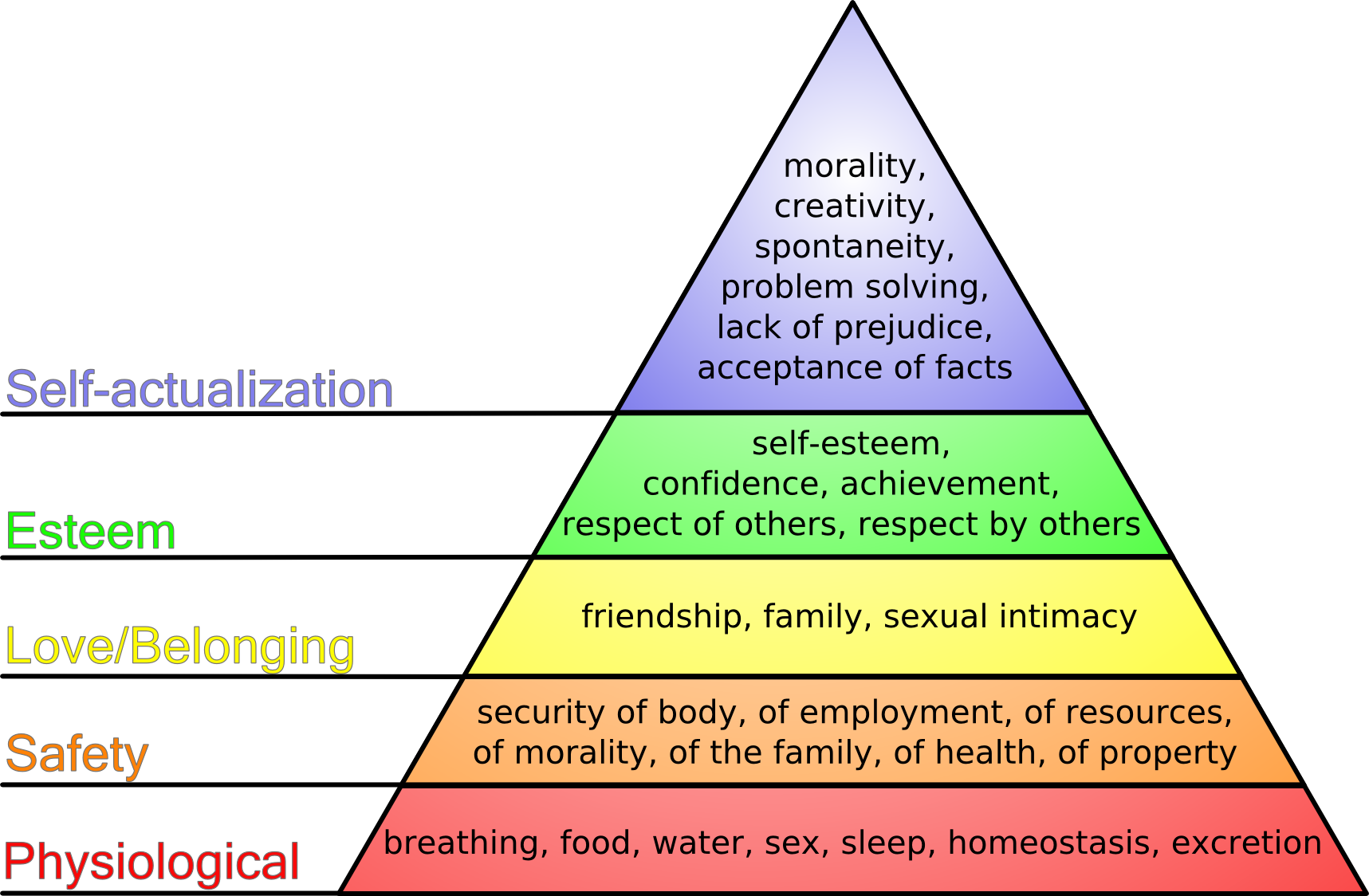
All of us have a wide variety of physical and social needs ranging from the need to breathe to the need to belong. Abe Maslow's "hierarchy of needs" is one of the most-disseminated ideas in academia:


Some of these needs are met in our intimate relationships. Self-determination theory, a comprehensive theory of human motivation, gives a slightly different take on our needs. Specifically, our needs encompass three spheres:
  •  The need for relatedness- We have a need to want to care for and help others and feel they care for us and want to help us in return. We want reciprocal relationships.
  • The need for autonomy- We have a need to be the original source for all our thoughts, beliefs, and behaviors. We want to feel like we're in the driver's seat of our lives.
  • The need for competence- We want to feel like we're capable and effective decision-makers. 
When all three needs are met, good things happen. We feel happy, complete, and secure. When one or more of the needs aren't being met, we suffer.

These needs can be met from a variety of social sources. In fact, many people will get these needs met from different sources. However, the people that help us meet all three needs are the people that we bond with the strongest.

If the person meeting the needs happens to be a romantic partner, even better things happen. Relationships that feature this dynamic have stronger attachment between partners, are more satisfying, and are more secure, all of which are predictors of relationship success.

If a partner doesn't meet one or more of these needs, the relationship may end... unless the person not getting their needs met have a high degree of separation anxiety. In that case, the relationship is likely to continue even if it is unfulfilling. Most current research suggests these individuals feel they are not worthy of a fulfilling relationship... which is another topic for another day.

Anyway, how can you make sure you're fulfilling your partner's needs? Let's take a look at each variable:
  • Relatedness: This one is simple- help your partner and be open to them helping you. This can take pretty much any form from chores to career decisions. Learn the art of altruism.
  • Autonomy: Autonomy is usually about choice. Allow your partner to make decisions without your influence. Learn the art of trust.
  • Competence: Give your partner positive feedback on a regular basis (and avoid negative feedback.) Learn the art of the genuine compliment.
That's it. That's all it takes to meet those needs. Of course, it may be easier said than done, especially if we're controlling, not inclined to be helpful, or like to be critical.

These needs don't have to be met by a partner; they can be met by others (friends, family, etc.) However, having a romantic partner that does meet these needs dramatically enhances our relationships.

My advice- work on it. Your significant other (and relationship health) will prosper!

###